

Health and Medical History of President
Theodore RooseveltLived 1858-1919
-- Thomas Marshall 1a

Health and Medical History of President
Theodore RooseveltLived 1858-1919


 Lived 1858-1919
2023
1776
Lived 1858-1919
2023
1776
 Revolutionary War
1776-1783
War of 18121812-1815
Mexican-American War1846-1848
Civil War1861-1865
Spanish-American War1898-1899
World War 11917-1918
World War 21941-1945
Korean War1950-1953
Viet Nam War1964-1975
Desert Storm1990-1991
Bush's Wars2001-2021
-- Thomas Marshall 1a
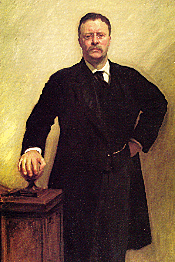
 |
UNDER CONSTRUCTION |








that the strain of the campaign was proving too much for Roosevelt. His voice was bothering him seriously. Reports reached the Bull Moose headquarters that he was losing his grip, that he was repeating himself disastrously. He was forced to cancel two addresses scheduled for the Middle West because of his throat. The disability was bad enough to raise the possibility that he could speak no more. 6aRoosevelt did not like to speak in the open air, for it put too much of a strain on his voice. 7a
Roosevelt was extremely lucky. He had the manuscript of a long, 50-page speech in his coat pocket, folded in two, and the bullet was no doubt slowed as it passed through it. He also had a steel spectacle case in his pocket, and the bullet traversed this, too, before entering Roosevelt's chest near the right nipple. Thus, one could say that Roosevelt's long-windedness and myopia saved his life! MORE
Although the bullet traveled superiorly and medially for about 3 inches after breaking the skin, it lodged in the chest wall, without entering the pleural space. Roosevelt was examined in a Milwaukee hospital MORE, (where he reluctantly allowed the surgeons to administer an injection of tetanus anti-toxin 1c), and then was observed for 8 days in a Chicago hospital. He was discharged on October 23, 1912 -- only a few days before the election. The bullet had effectively stopped Roosevelt's campaign. He finished second to Woodrow Wilson, but ahead of the incumbent President, William Howard Taft. The bullet was never removed, and caused no difficulty after the wound healed. 8
The details of the assassination attempt and its aftermath are described in 7b.

Loud snoring raises the possibility of sleep apnea. Hypersomnolence would be an additional sign of sleep apnea. Was Roosevelt hypersomnolent? During his Presidency, at least, he was not. The White House usher observed 10a:
President Roosevelt slept well at night, but never in the day. He liked to read in the evening after all was quiet. The usual retiring hour was about ten-thirty, but it was always with difficulty that the President was persuaded to turn in at that time. He would promise to come along in a minute, but would immediately become absorbed in a book or magazine and it was generally after much effort and much persuasion that he would finally turn in for the night. Mrs. Roosevelt would call and call. The sound of her voice calling "The-o-dore!" is well remembered by all the older employees. She often appealed to me to go to the President and "see if you cannot persuade him to come to bed." No matter how late he sat up, he always arose at the same time in the morning and always appeared refreshed and hearty.Nor did Roosevelt show signs of excessive daytime somnolence on the campaign trail in 1912. While stumping in Milwaukee, one of Roosevelt's intimates wrote: "We had a few minutes before dinner, and the Colonel took a little nap sitting in a rocking-chair in his room. It was the only time, in all the campaign trips I made with him, that I ever saw him sleep before bedtime." 7c





Had Roosevelt not died at the young age of 60, it is quite likely that he would have been elected President in 1920. At the very least, "He would not need to lift a finger this time [as opposed to 1912], and the [Republican presidential] nomination would still be his" 14a.
Interestingly, Harding might have been Roosevelt's Vice President [Ibid.]. If Roosevelt had lived, say, three years longer, and Harding still had died in 1923, then the Secretary of State would have succeeded to the Presidency under the law then in effect.
- In 1884 his first wife, Alice Lee Roosevelt, and his mother died on the same day -- his wife of Bright's disease, his mother of typhus. Roosevelt spent much of the next two years on his ranch in the Badlands of Dakota Territory. There he mastered his sorrow as he lived in the saddle, driving cattle, hunting big game -- he even captured an outlaw.
- This anecdote illustrates Roosevelt's attitude to public service:
The Missouri Governor [Herbert S. Hadley] was not in rugged health at that time, and in the talk with Colonel Roosevelt he mentioned the possibility that the presidency, if he should be nominated and elected, might kill him. The Colonel replied that in his judgment it was worth the sacrifice; that the presidency of the United States was the greatest task that could be laid upon any man, and that to fulfill it worthily was paramount to every consideration of personal welfare. 7f
- It took two deaths to make Roosevelt president: (1) President William McKinley, obviously, and (2) Vice President Garrett Hobart. Hobart was Vice President during McKinley's first term as President, but had died during that first term. Hobart and McKinley were close; certainly Hobart would have been on the ticket for McKinley's second term if he had lived. However, Hobart's death from heart disease at age 55 opened the door for Roosevelt to be selected as McKinley's second-term VP.
- For no particular reason, Roosevelt and a few companions rode 98 miles on horseback in one day, from the White House into northern Virginia and back, through terrible winter weather. A newspaper wrote: "The President rode horseback ninety-eight miles in one day, and was able to sit down comfortably for a late dinner. What's the use of Congress trying to spank a man like that?" 15a
- Roosevelt favored euthanasia. Referring to his South American trip, he said:
I have always made it a practice on such trips to take a bottle of morphine with me. Because one never knows what is going to happen, and I did not mean to be caught by some accident where I should have to die a lingering death. I always meant that, if at any time death became inevitable, I would have it over with at once, without going though a long-drawn-out agony from which death was the only relief. 7g
- Roosevelt's White House physician was Dr. Presley M. Rixey. New York physician Dr. Alec Lambert was a close personal friends of Roosevelt's. Dr. William Osler consulted at the White House [Bliss]
- A well-dressed man arrived at the White House one evening, asking to speak to Roosevelt (without an appointment). The President came downstairs, talked to him, and quickly realized he was dangerous. "Pretending to call for drinks, Teddy Roosevelt marched out of the room, muttering to the butler to `get that crackpot out of here.'" A search revealed he was carrying a loaded gun. 5d
- Smoking in the White House was forbidden by Roosevelt 15b.
- Roosevelt was a distant relative of President Martin Van Buren 16a. He was a fifth cousin of Franklin Roosevelt; their common ancestor, Nicholas Roosevelt, lived in New York from about 1658 to 1742 16b.
- The proper pronounciation of Roosevelt's last name rhymes the first syllable with "rose." MORE The family name came from ancestor Claes Martensen, who changed his name to Claes van Rosevelt (meaning: "from the world of roses") upon coming to America in 1650 5e.
- William Osler
- Presley Marion Rixey
- William Clarence Braisted
- James Chambers Pryor
- Cary Travers Grayson
- John H. Oliver
- George J. Cook
- Henry C. Jameson
- James Julius Richardson
- Presley Marion Rixey
- George A. Lung
- Robert Maitland O'Reilly
- Newton Melman Shaffer
- Edward R. Stitt
- J. F. Urie
- William Holland Wilmer


- Manners, William. TR and Will: A Friendship that Split the Republican Party. New York: Harcourt, Brace & World, Inc., 1969.
 a pp.310. Marshall was Wilson's Vice-President and is best known for his remark: "What this country needs is a good five-cent cigar." b p.8 c p.286 d p.295 e p.303 f p.300 g p.306
- McCullough, David. Mornings on Horseback. NY: Simon and Schuster, 1981.
a pp.36, 44, 59, 63, 70, 79, 81-82, 89, 90-108, 110-113, 133, 189, 190, 212, 229, 249, 340, 367
- Boller, Paul F. Jr. Presidential Anecdotes. New York: Oxford University Press, 1981.
 a p.201
- Roosevelt, Theodore (introduction by H.W. Brands). The Naval War of 1812. NY: DaCapo Press, 1999 (original 1882).
a pp.xvii-xviii
- Parks, Lillian Rogers. My Thirty Years Backstairs at the White House. New York: Fleet Publishing, 1961.
a pp.83 b p.30 c p.104 d p.60 e p.277
Comment: This book stayed on the New York Times best-seller list for 26 weeks, prompting Jacqueline Kennedy to require all staff at the White House to sign a pledge agreeing not to write about their experiences (NY Times, page B8, Nov. 12, 1997). Parks's mother, a maid at the White House from 1909-1939, had actually been encouraged by Eleanor Roosevelt to write and publish a memoir (p260).
- Pringle, Henry F. The Life and Times of William Howard Taft: A Biography. New York: Farrar & Rinehart, Inc., 1939.
 a p.836 b p.912
 - Davis, Oscar King. Released for Publication: Some Inside Political History of Theodore Roosevelt and his Times 1898-1918. Boston: Houghton Mifflin, 1925.
a pp.216, 356, 367 b pp.374-393, 398 c p.373 d p.429 e p.458 f p.303 g p.434
- Foley, WJ. A bullet and a Bull Moose. JAMA. 1969;209:2035-2038. Pubmed: 4897364.
- Boulware MH. Snoring: New Answers to an Old Problem. Rockaway, NJ: American Faculty Press, 1974.
Comment: Cited by: Fairbanks DNF. Snoring: an overview with historical perspectives. Pages 1-16 in: Snoring and Obstructive Sleep Apnea. 2nd ed. Fairbanks, David N. F. and Fujita, Shiro (eds.). NY: Raven Press, 1994.
- Hoover, Irwin Hood (Ike). 42 Years in the White House. Boston: Houghton Mifflin Company, 1934.
a p.270
Comment: The Library of Congress contains more of Hoover's first-hand recollections of eight presidents.
- Smith, Ira R. T.; Morris, Joe Alex. "Dear Mr. President:" The Story of Fifty Years in the White House Mail Room. New York: Julian Messner, 1949.
a p.52
Comment: Ira Smith was a peppery fellow who ran the White House mail room from 1897 to 1948. He started working during the administration of William McKinley and was the only mail room staffer until the volume of mail made it necessary to hire help during the administration of Franklin Roosevelt.
- Ross, Ishbel. An American Family: The Tafts - 1678 to 1964. Cleveland, OH: World Publishing Co., 1964.
a p.308
- Available on the web: http://www.theodoreroosevelt.org/life/NYTobit.htm
- Russell, Francis. The Shadow of Blooming Grove: Warren G. Harding in His Times. New York: McGraw-Hill, 1968.
 a p.311
 - Bromley, Michael L. William Howard Taft and the First Motoring Presidency. Jefferson, NC: MacFarland, 2003.
 a p.72 b p.16
- Montgomery-Massingberd, Hugh (ed). Burke's Presidential Families of the United States of America. 2nd ed. London: Burke's Peerage Limited, 1981.
 a p.184 b pp.411, 495
Comment: Maps -- in great detail -- the ancestors and descendants of American presidents through Ronald Reagan. They would have had an exhausting time with President Obama's family tree! MORE